

A field watch should be the watch you reach for without planning your day around it. You can read it quickly, wear it comfortably, and get on with what you are doing. That practical approach runs through our field watches collection, from designs rooted in WWII to the compact watches associated with the Vietnam era.
But a clear dial and a sturdy case only tell part of the story. Our first watch began with Tom Rice's lost wristwatch from D-Day. The Rec Spec grew out of conversations about watches used by reconnaissance teams in Vietnam. Here are six of our picks for 2026, from $195 quartz models to a Swiss hand-wound Type 44 starting at $555, and the differences that matter when choosing one.
Our picks at a glance
| Model | Movement | Case size | Price in USD |
|---|---|---|---|
| A-11 Type 44 White | Hand-wound | 32mm or 38mm | From $555 |
| A-11 Utah Beach Sand MK2 Higgins Blue | Automatic | 38mm | From $495 |
| Tom Rice Black Canvas | Automatic | 38mm or 42mm | $269 |
| Rec Spec OG Sunray | NH36 automatic, day-date | 38mm | From $295 |
| Jungle Field OG | VH31 quartz | 34mm | $195 |
| Jungle Field Popcorn Patina | VH31 quartz | 34mm | $195 |
What makes a real field watch?
A field watch is built around readable timekeeping in a case you can wear through an ordinary working day. The design makes sense when you think about the job: the wearer needs to check the time quickly, often while doing something else. Hands that disappear against the dial or a case that gets in the way make that job harder.
That is why contrasting markings, a clear minute track, and luminous hands are so familiar. They help you find the time without studying the dial. A restrained case finish reduces reflections, while a secure strap keeps the watch where you can read it. Water resistance matters too, although the exact rating and care guidance depend on the model.
Size is about fit. Around 36 to 40mm works for many wrists, but older field-watch proportions can be considerably smaller. Our 34mm Jungle Field leaves more wrist exposed than a 42mm Tom Rice, and both can be sensible choices for different people. Look at the lug span and thickness alongside the diameter.
The movement can be quartz, automatic, or hand-wound. Each gives you a different ownership routine. The useful question is whether you want battery-powered convenience, the automatic winding of regular wrist movement, or the daily interaction of winding the watch yourself.
Six field watches worth a closer look
A-11 Type 44 White: for manual winding and WWII proportions
The A-11 Type 44 White is our interpretation of the WWII A-11, with a black dial, white markings, and the compact proportions that give the original design its character. It is the model we would start with if your interest in field watches comes from the equipment of the 1940s.
We offer it in 32mm and 38mm. The smaller version keeps that distinctly compact feel; 38mm gives the dial more room on a modern wrist. A stainless steel case rated to 10 ATM makes it a watch for regular use, with leather, canvas, and Bonklip bracelet options changing its appearance.
Inside is a Swiss manual-wind movement. Turning the crown winds the mainspring, storing the energy that drives the hands. There is no automatic rotor doing it for you. That winding routine is part of owning this version of the A-11, and part of its appeal. Prices start at $555.

Higgins Blue: for a dial with a connection to Normandy
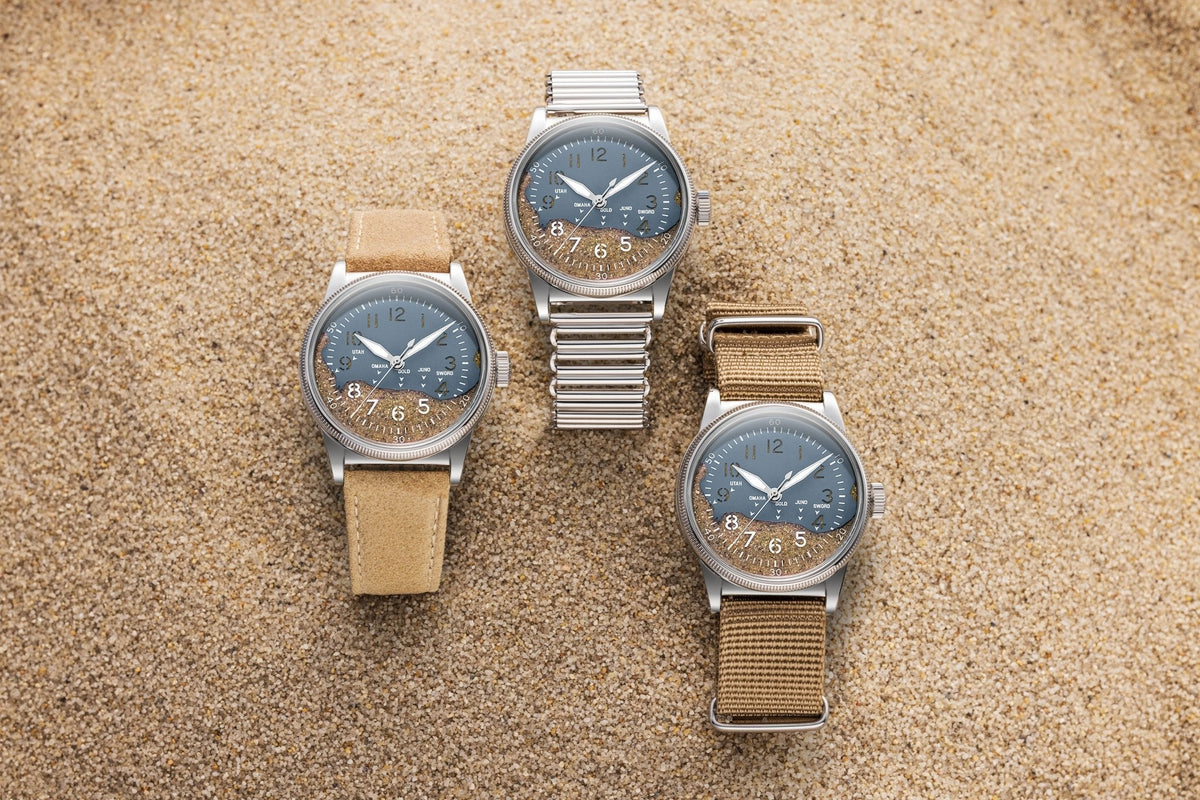
The A-11 Utah Beach Sand MK2 Higgins Blue was made to commemorate the Normandy landings, using sand collected from Utah Beach inside the dial. It brings the place itself into a modern automatic watch.
The blue upper dial has an opening shaped around the Normandy coastline, with the five landing beaches marked across it. Sand shows through from underneath. Look at the dial from an angle and you can see how the two layers work together: the coastline sits above the material it reveals.
At $495 on Sand Leather, it combines that construction with a 38mm case. This is the pick for someone who wants the D-Day connection visible on the face of the watch, alongside the time.

Tom Rice Black Canvas: an automatic at $269
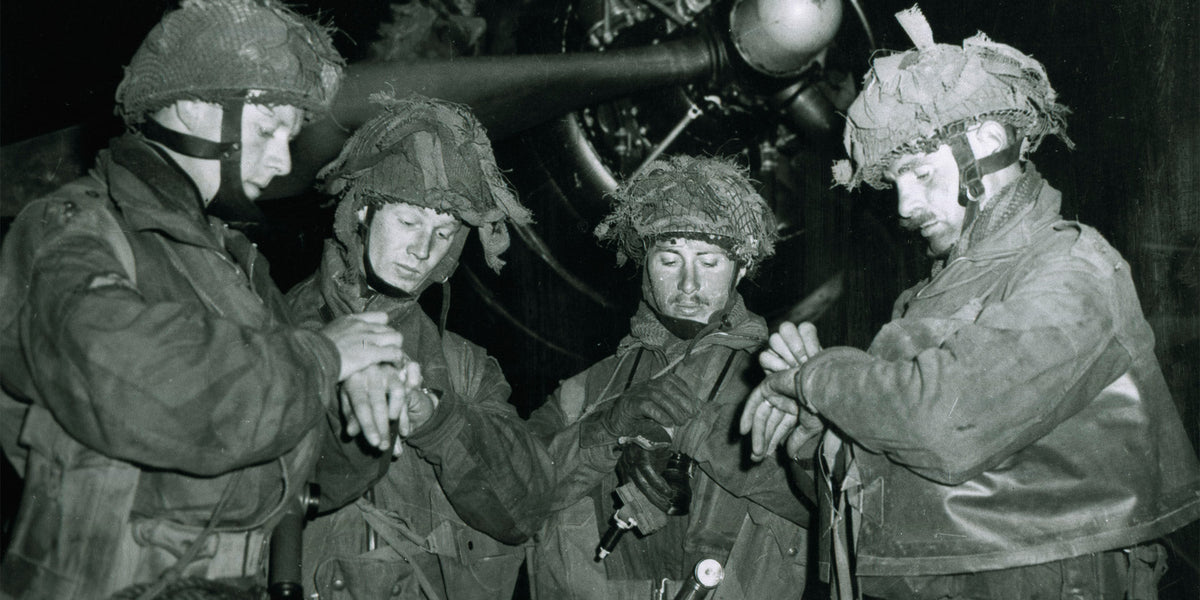
The Tom Rice Black Canvas belongs to the collection that started Praesidus. Our first model was based on the wristwatch Tom Rice lost during his D-Day jump, developed through our work with the veteran himself. That is where its nickname, the “Lost Watch of D-Day,” comes from.
The modern watch pairs a black dial and warm-colored numerals with an automatic movement. It is $269 on canvas, making it the most accessible automatic in this selection. The connection to Rice gives the watch its identity; the numbered dial and straightforward layout make it easy to wear every day.
You can choose 38mm or 42mm. The automatic movement winds through wrist motion, with a rotor inside turning to wind the mainspring. It is a different routine from the manual Type 44, particularly if this will be the watch you wear most days.

Rec Spec OG Sunray: for a day-date display
The Rec Spec OG Sunray comes from a different chapter of field-watch history. Our conversations with former MACV-SOG member John “Tilt” Stryker Meyer led us to the civilian watches used by reconnaissance personnel in Vietnam. Their dress-watch origins help explain the sunray dial and calendar display, details that look quite different from a wartime A-11.
Our Log Book article on MACV-SOG watches follows that background. The Rec Spec carries the design into a 38mm watch, with green luminous markings and an NH36 automatic movement supplying the day-date window. Its crown sits near 4 o'clock, moving it away from the back of your hand.
Prices start at $295. The raised K1 sapphire-coated mineral crystal adds to the vintage profile. Its mineral-glass base has a surface designed to improve scratch resistance over ordinary mineral glass, at a more accessible price than solid sapphire.
Jungle Field OG: compact quartz at $195
The Jungle Field OG takes its cues from the compact GG-W-113 service watches of the Vietnam era. Our history of the GG-W-113 design explains that starting point. The modern Jungle Field keeps the small proportions: 34mm across and 9.4mm thick including its crystal. A sandblasted finish cuts down reflections from the case. On the dial, white markings stand out against matte black.
The $195 price includes a VH31 quartz movement. Watch the seconds hand: it advances in smaller steps than the familiar once-per-second tick of many quartz watches. It runs on a battery, so leaving it unworn between weekends does not use up a mechanical power reserve.
Its sapphire-coated mineral crystal sits above the dial, and the case has a 5 ATM rating. The lugs are 18mm apart. Keep that measurement in mind if you already own a box of 20mm straps, because they will not be the right fit for this watch.
Jungle Field Popcorn Patina: the same compact idea, more dial texture
Put the Jungle Field Popcorn Patina beside the OG and the dial surface is the first difference. Fine bumps break up the black background, behind warm patina-colored numerals. Light Brown Canvas carries those warmer colors out beyond the case.
The price is still $195, and you get the same 34mm size and battery-powered VH31 movement. Choose between these two by looking at the markings at normal reading distance: the OG has the cleaner black-and-white contrast, while Popcorn Patina has more texture to inspect up close.
What each budget gets you
At $195, both Jungle Field models give you a compact quartz watch. Choose the OG for its plain matte dial or Popcorn Patina for the textured finish. Their shared movement and size make that a straightforward comparison.
Below $300, the Tom Rice and Rec Spec bring automatic movements into the selection. The Tom Rice starts at $269 on canvas; the Rec Spec starts at $295 and adds a day-date display. Its 4 o'clock crown also makes it fit differently, so the extra money changes more than the dial color.
Around $500 to $555, the decision changes again. Higgins Blue puts Utah Beach sand beneath a coastline-shaped opening, while the Type 44 gives you a Swiss manual-wind movement and a choice of 32mm or 38mm proportions. Spend the extra on the detail you actually want to use or look at.
How to choose your field watch
Check fit beyond the diameter
Use a comfortable watch you already own as a reference. Compare how far its lugs extend and how high the case sits. Our 38mm field watches provide a useful middle ground, but a smaller case may suit you better. Bend your wrist when trying one on; the crown and caseback matter as much as the view from above.
Pick a movement you will enjoy owning
If you rotate watches often, quartz keeps running between wears without winding. An automatic will stop once its stored energy runs down. Choose the Type 44 if winding a mechanical watch is something you enjoy, rather than a routine you would prefer to avoid.
Choose the strap for your day
Canvas, leather, and pass-through nylon change how a watch sits. A traditional NATO adds fabric beneath the case. A two-piece strap leaves the caseback against your wrist. For repeated water exposure, check both the watch's care instructions and the strap material; leather benefits from avoiding prolonged soaking.
If $500 is your firm limit, our field watches under $500 guide narrows the range around that budget.
Field watch vs dive watch vs pilot watch
Field watches emphasize readable everyday timekeeping and manageable proportions. Dive watches add features for underwater use, commonly including an elapsed-time bezel. Pilot watches vary considerably, from simple three-hand layouts to chronographs with additional timing displays. Their histories overlap, so the label alone will not tell you what a particular watch can do.
Start with the feature you need. A chronograph is useful for timing an interval; a clear three-hand dial may be easier to read at a glance. For swimming or diving, check the exact model's intended use. Our field watch vs dive watch guide explains that comparison in more detail.
Field watch FAQ
What is a field watch?
A field watch is a practical wristwatch built around readable timekeeping and everyday wear. Common features include contrasting hands and markings, a durable case, and a secure strap. Modern field watches use quartz, automatic, or hand-wound movements, with sizes and water-resistance ratings that vary by model.
What size should a field watch be?
Choose a case whose lugs sit comfortably within your wrist, then check thickness and crown position. Around 36 to 40mm is a useful starting range, but smaller watches can fit very well. Our 34mm Jungle Field is a compact option; several other picks offer 38mm cases.
Are field watches waterproof?
Field watches have model-specific water-resistance ratings, not unlimited protection from water. Check the manufacturer's care instructions for swimming and other exposure. The condition of seals, crown position, and strap material all matter. A nylon strap can tolerate water without changing the rating of the watch attached to it.
Automatic or quartz for a field watch?
Quartz suits someone who wants battery-powered convenience between wears. An automatic suits someone who enjoys a mechanical movement that winds through wrist motion. If you leave an automatic unworn long enough, it will need winding and setting again. Choose the routine you prefer, alongside fit and dial readability.


Leave a comment
This site is protected by hCaptcha and the hCaptcha Privacy Policy and Terms of Service apply.