

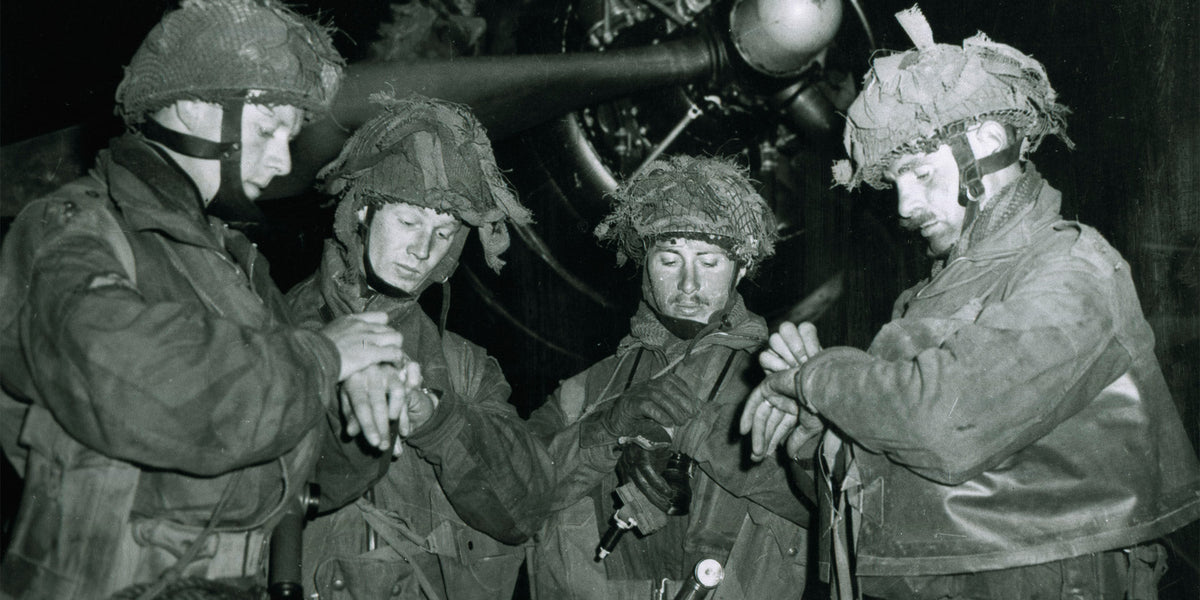
Cover: British pathfinders synchronizing their watches, June 5, 1944. National Army Museum, NAM. 1985-11-36-197. Out of copyright.
Before the aircraft took off for Normandy, four British pathfinders stood together checking their watches. The June 5, 1944 photograph catches a small part of preparing for an enormous operation: making sure the men agreed on the time. That practical role sits behind the history we commemorate in our D-Day watch collection.
So what watches did soldiers wear on D-Day? Issued service watches and personal wristwatches both went into the invasion. The A-11 was an American wartime specification, while British forces had their own issued equipment. Individual accounts and surviving watches give us a closer view of what those broad categories meant to the men carrying them.
Why time mattered on June 6, 1944
The airborne landings began during the night, ahead of the seaborne assault. Offshore, ships prepared landing craft while naval gunfire and aircraft attacked the defenses. H-Hour identified the scheduled start of an assault, with timings set for the different landing areas.
The National WWII Museum's D-Day timeline puts naval fire at Utah Beach at 5:50 a.m. and the first landings at Utah and Omaha at 6:30 a.m. At Omaha, the preparatory naval bombardment ended just before the troops reached shore. Those movements depended on an agreed timetable, even when weather, navigation, and enemy fire disrupted the plan.
A wristwatch made that reference portable. Men could check it while moving, without finding a clock or asking someone else. A clear dial helped; being able to set the seconds accurately made synchronization easier.
The A-11: Built to Agree on the Second
A black dial, white hands and markings, and a central seconds hand made the A-11 straightforward to read. The U.S. Army's February 1943 A-11 specification put those requirements down on paper, along with manual winding and a mechanism for setting the seconds. This was a defined type of navigational watch, not a catch-all name for every American military wristwatch.
The A-11’s hacking mechanism stops the seconds hand while you set the time, then lets you restart it against a reference. Two men could bring their watches into agreement instead of carrying slightly different versions of the time.
The movement was wound by hand. Turning the crown stored energy in the mainspring, which then drove the hands. Keeping the watch running was part of looking after it.
Tom Rice's Watch Never Made It to the Ground With Him
Tom Rice served in C Company, 501st Parachute Infantry Regiment, 101st Airborne Division. He was carried by C-47 from England to Normandy for the June 6 jump.
He recalled a difficult exit from the aircraft. Caught at the door, he struggled to break free, and his wristwatch was torn away. The watch never reached the ground with him.
Decades later, that lost watch became the starting point for our work with Rice. His account is preserved in The Lost Watch of D-Day. That conversation eventually led to our first watch project, nicknamed the “Lost Watch of D-Day.”
A Different Watch on Omaha Beach
Private Harold Baumgarten landed in the first assault wave with the 116th Infantry Regiment. The watch he wore survived and is now in The National WWII Museum's collection.
A fellow soldier, Robert Garbett Jr., made its protector. Garbett was killed on D-Day.
A personal watch, protected by a friend's handiwork, went into the first wave at Omaha. Wartime watch use included the things men brought with them, not only equipment described in a military specification.
British and Commonwealth troops
The June 5 pathfinder photograph shows British troops preparing their watches for the operation. It does not show enough detail to identify the models. Their equipment came through a different supply system from that of the American forces.
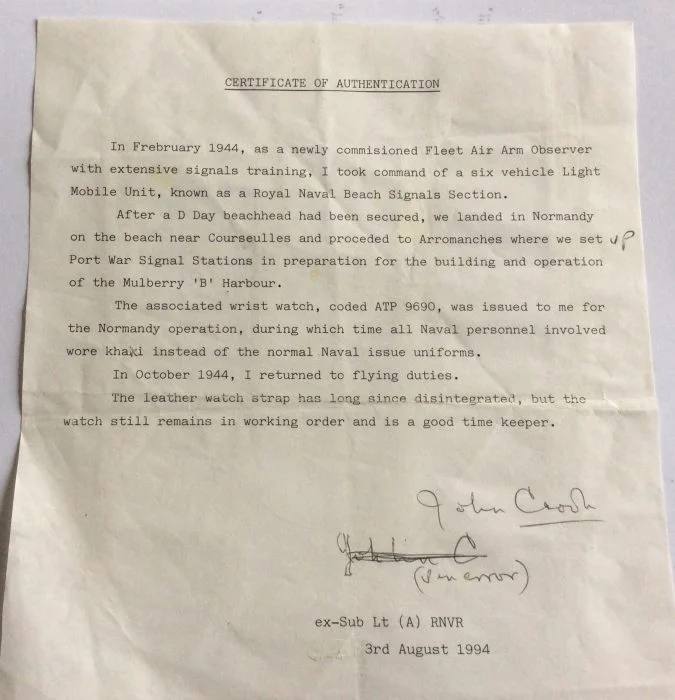
One surviving account names a British-issued watch more precisely. In a signed letter from August 1994, naval officer John Crook described his watch as ATP 9690. He commanded a Royal Naval Beach Signal Section and helped establish communications at Arromanches.
Crook described coming ashore after a beachhead had been secured. His ATP watch belongs to the Normandy campaign, without establishing that he wore it ashore on June 6 itself.
Who made the A-11 watches?
Several American makers built watches to the A-11 specification. The designation describes a set of requirements, rather than a single maker's model name. Surviving examples can differ in detail while meeting the same requirements. Our A-11 history follows the development in more detail.
Remembering the Landings in a Modern Watch
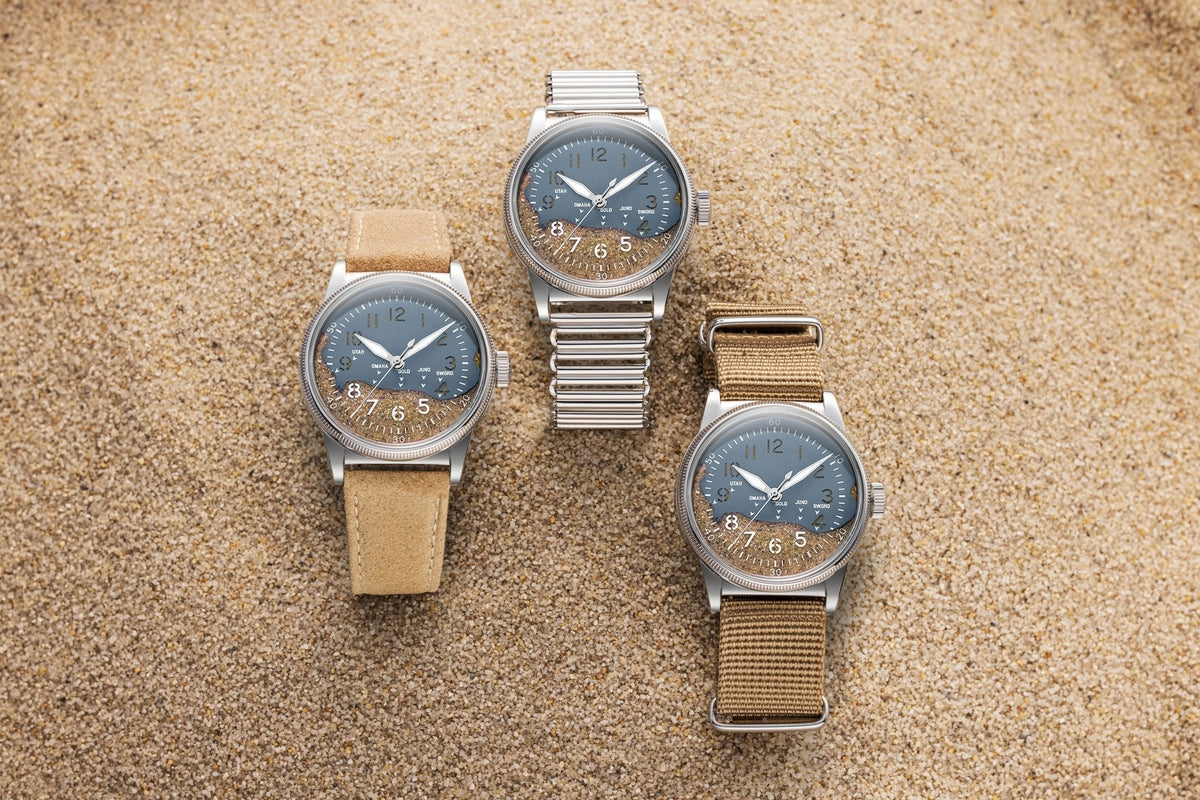
Our A-11 Utah Beach Sand MK2 Higgins Blue, $495 on Sand Leather, uses a coastline-shaped opening to reveal sand collected from Utah Beach. The five landing beaches are marked across the dial. The material sits beneath the upper surface, giving the map physical depth. Our Utah Beach owner guide explains the earlier sand-dial design and its connection to the beach.

The Neptune 44 Black, $550, brings that connection to the case. Its steel cases were submerged off Utah Beach as part of an aging process, producing variations in their surface appearance. The black dial has aged-looking markings, and the watch is offered in 38mm and 42mm sizes.
These modern watches give you two different connections to Utah Beach. Choose Higgins Blue for the map and sand visible on its dial, or Neptune 44 for a case whose finish comes from exposure to the coastal waters. Both commemorate the landings through how they are made.

D-Day watch FAQ
What watch did American soldiers wear in WWII?
American servicemen used issued watches and personal wristwatches. The A-11 was one type produced to a U.S. military specification. Harold Baumgarten's surviving personal watch provides another example. There was no single watch worn by every American soldier throughout the war.
What is an A-11 watch?
The A-11 was a U.S. military watch specification. Its requirements included manual winding, a clear dial with a central seconds hand, and a mechanism allowing precise time setting. Several American makers produced watches to the specification. Modern A-11-inspired watches are newly made interpretations of that wartime design.
Did paratroopers wear watches on D-Day?
Yes. Tom Rice recalled losing his wristwatch during his jump into Normandy on June 6, 1944. A June 5 photograph also shows British pathfinders synchronizing watches before departure. Those examples document watch use without establishing that every paratrooper wore the same model or received identical equipment.
Why did WWII watches have hacking seconds?
A hacking mechanism stops the seconds hand when the watch is set. The wearer can align it with a reference and restart it at the agreed moment. This helped men synchronize their watches before separating. The feature was useful for coordination, although it was not present in every wartime wristwatch.

Leave a comment
This site is protected by hCaptcha and the hCaptcha Privacy Policy and Terms of Service apply.