

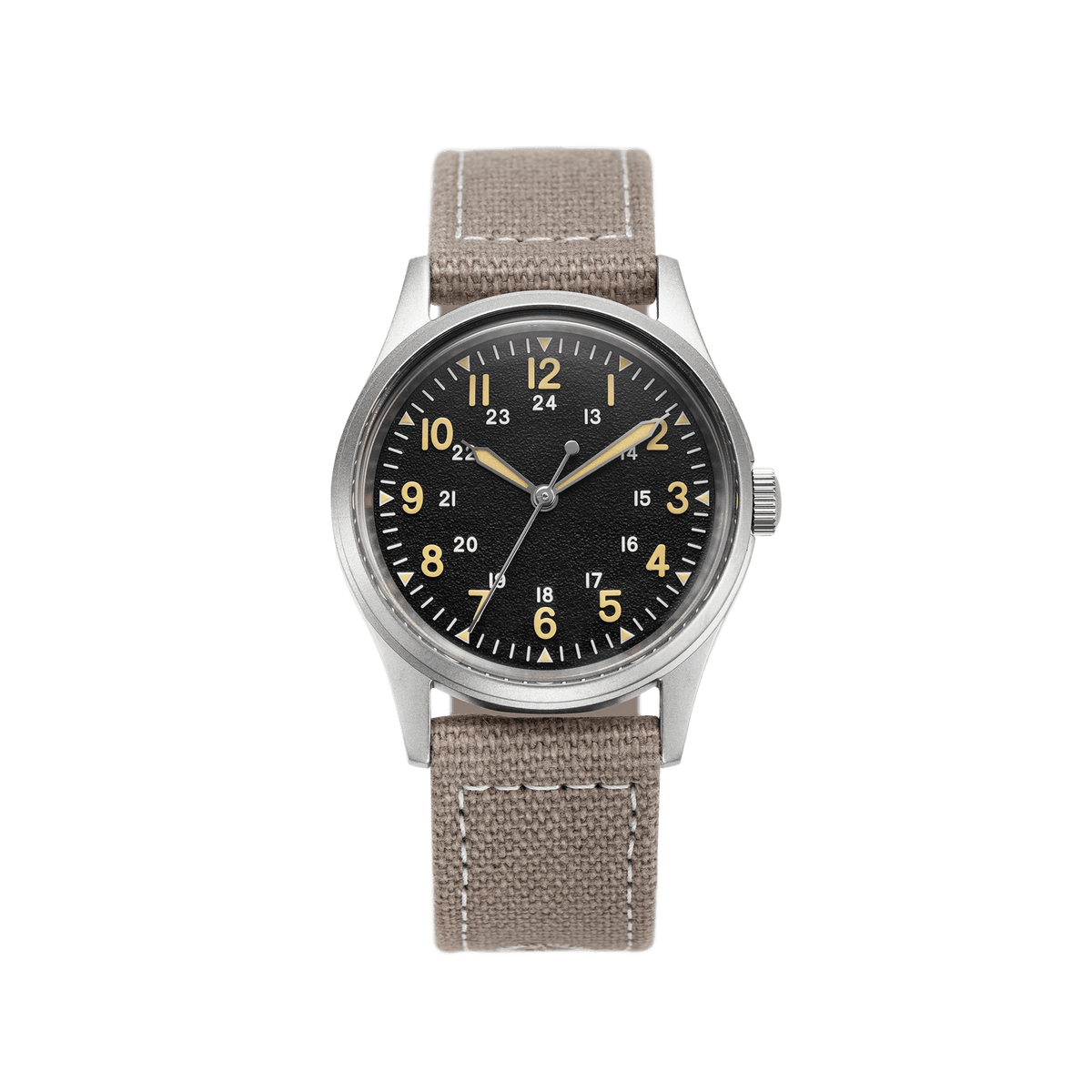
The watches that helped establish the field-watch look were often surprisingly small. Their job was to put readable time on a wrist, without making the watch itself another thing to manage. That still explains much of the appeal: clear numbers, useful hands and a case you can comfortably wear all day.
A field watch is a practical everyday watch rooted in military wristwatch design, usually with an easy-to-read dial and a straightforward layout. Our Praesidus field watches follow that approach, but the category contains more variety than a black dial on a canvas strap might suggest. Understanding where those details came from makes choosing one much easier.
The history starts before World War II
Military wristwatches existed before the familiar WWII designs. The Australian War Memorial preserves a watch belonging to Private Arthur Marshall Nicholson, made around 1915–1917, with a metal mesh guard protecting its face. It is a very literal response to a practical problem: putting a watch on the wrist made it accessible, but also exposed it to knocks. The surviving watch and its guard show how that problem was addressed during the First World War.
WWII brought other approaches, including the American A-11. If that name sounds like a model, it is worth understanding that it identified a wartime watch type rather than one modern retail collection. The Henry Ford’s collection includes a Waltham-made Type A-11 navigation wristwatch dated 1943–1945. Its aviation connection is a useful reminder that the history behind today’s field watches wasn’t confined to infantry equipment.
What carries across is the priority given to reading the time. Large Arabic numerals, distinct hands and a clearly marked minute track make sense when a glance needs to tell you something useful. Those features also explain why the design works so well away from its original setting. You don’t need to recreate the watch’s past to appreciate a dial that is easy to read.
What does GG-W-113 mean?
GG-W-113 is another name you’ll encounter when looking at field watches, especially Vietnam-era designs. It refers to a US federal wristwatch specification, not a movement or a brand. The official specification record lists its Revision A dated June 6, 1967.
Its requirements included luminous hands and dial markings, a sweep seconds hand and a mechanism to stop that seconds hand. This last feature is often called hacking seconds. Stop the hand while setting the watch, then restart it against a reference time, and it becomes easier to synchronize watches precisely.
That tells you more about the purpose of these watches than the color of a strap does. The details had jobs. A modern field watch can borrow the readable layout without being an issued watch or claiming compliance with an old government specification. When shopping, separate the design’s inspiration from the actual specifications of the watch in front of you.
The details that make a field watch useful
Start with the dial
A good field-watch dial should make the hour and minute hands easy to distinguish. Contrast matters, but so does how much information shares the space. A minute track is useful; an extra scale is useful only if you can read both comfortably.
Some field watches have an inner 13–24 scale. It lets you read afternoon and evening hours in 24-hour time without doing the conversion in your head. It doesn’t turn the watch into a second-time-zone watch: the hour hand still goes around the dial twice each day. Other field watches leave the inner dial open. Neither layout is compulsory.
Luminous material can help in low light, but its performance varies. Look at how much of the hands and dial is illuminated, not simply whether the specification includes the word “lume.” A daytime product photograph won’t tell you how long the markings remain readable in darkness.
Choose proportions you actually enjoy wearing
Small cases belong naturally in this history. They aren’t a concession made only for small wrists. But a historical connection isn’t a reason to buy a watch that feels wrong on you, either.
Check the diameter alongside the lug-to-lug length, which measures the watch from the tip of its upper lugs to the tip of its lower lugs. Those lugs determine how far the watch extends along your wrist. Thickness and strap construction then change how it sits. A smaller watch on a thick strap can feel quite different from the same diameter on a slim one.
Our watch size guide walks through those measurements. If you’re between sizes, compare them with a watch you already wear comfortably rather than choosing the largest diameter your wrist can accommodate.
Match the movement to your routine
A field watch can be quartz, automatic or manually wound. Its movement doesn’t decide whether it belongs in the category.
Quartz is convenient if you want to pick the watch up and go, including after several days without wearing it. An automatic mechanical watch winds its mainspring through wrist movement, which suits regular wear. A manual-wind watch asks you to supply that energy through the crown. Some people enjoy that small routine; others would rather avoid it.
Choose the routine first, then look at the particular movement. There’s no need to turn an everyday watch into a chore to make it feel more historically convincing.
Read the water-resistance specification
A rugged appearance isn’t a water-resistance rating. Check the manufacturer’s guidance for the specific watch and the activity you have in mind. A field watch isn’t automatically a dive watch, and a leather strap may be a poor choice for repeated soaking even when the case has suitable water resistance.
The same practical thinking applies to the crystal and strap. Consider scratches, comfort, replacement and how you will use the watch, rather than treating one material as the right answer for every owner. A strap you like wearing matters more than whether it looks right in a staged outdoor photograph.
Three ways we approach the field watch
Jungle Field: the later service-watch layout
The Jungle Field Popcorn Patina on light brown canvas takes its design cues from the GG-W-113 tradition. You can see that direction in the clear outer numerals and inner 24-hour scale. The textured black dial gives this version its own character without abandoning the straightforward layout.
Its 34mm case keeps the proportions compact. Inside, a TMI VH31 quartz movement moves the seconds hand in smaller steps for a sweeping appearance. That makes it a useful choice if you like the look and proportions of an older field watch but want battery-powered convenience rather than a winding routine.
A-11 Type 44: getting closer to the original proportions
The A-11 Type 44 Patina on dark brown leather grew from a closer look at an original wartime A-11. During development, acquiring a 1944 example changed our thinking about size and helped bring a 32mm version into the project alongside the planned 38mm watch. Handling the proportions of an original gave the design a more specific starting point than simply making something that looked old.
The 38mm version is for someone who prefers a little more presence on the wrist. The current Type 44 uses a Swiss-made Landeron L21 manual-wind movement. Its appeal is the combination of that A-11 shape and the regular interaction of winding it yourself.

Tom Rice A-11: the watch that started our project
The Tom Rice A-11 on brown leather belongs to the collection that started Praesidus. The WWII paratrooper’s account of losing his watch during his D-Day jump gave the project a personal starting point: a watch connected to a man’s experience.
Assembled in the USA, this version pairs that A-11-inspired identity with an NH35 automatic movement. This 38mm model suits someone who wants a mechanical watch for regular wear and prefers automatic winding. Its broad hands and open black dial make the practical side of the design immediately visible.

How to choose your first field watch
Start with the dial and proportions. Those are the things you’ll notice every time you wear it. Then choose a movement routine that fits your life and check the water-resistance and strap guidance for your actual use.
The Jungle Field offers compact sizing and quartz convenience. The Type 44 puts more emphasis on the wartime A-11 form and manual winding. The Tom Rice A-11 gives you an automatic route into the collection that began Praesidus. If you’d like a wider comparison after settling on those priorities, our best field watches guide looks at the available options in more detail.
Field watch FAQs
What is a field watch?
A field watch is a practical wristwatch influenced by military timekeeping designs, usually with clear numerals, easily distinguished hands and a simple layout. Today it is a broad watch category, not a universal certification. Individual models vary in size, movement, materials and water resistance, so check their actual specifications.
Does a field watch have to be mechanical?
No. Field watches can use quartz, automatic or manual-wind movements. The category describes the watch’s design and practical purpose, not a single power source. Quartz suits low-maintenance everyday use, while automatic and manual-wind watches offer different ways to live with a spring-powered mechanical movement. Choose the routine you prefer.
What is the difference between a field watch and a military-issued watch?
A field watch can take inspiration from military designs without ever being issued to service personnel. An issued watch has a specific procurement or service history. A historical-looking dial, canvas strap or model name does not establish that history, nor does it prove compliance with a government specification.
Can you wear a field watch every day?
Yes, provided the individual watch suits your activities and feels comfortable. Readability and a relatively simple layout make field watches useful daily companions. Check water resistance, strap suitability and care instructions before swimming or other demanding use, and choose a movement whose winding or battery requirements fit your habits.


Leave a comment
This site is protected by hCaptcha and the hCaptcha Privacy Policy and Terms of Service apply.