

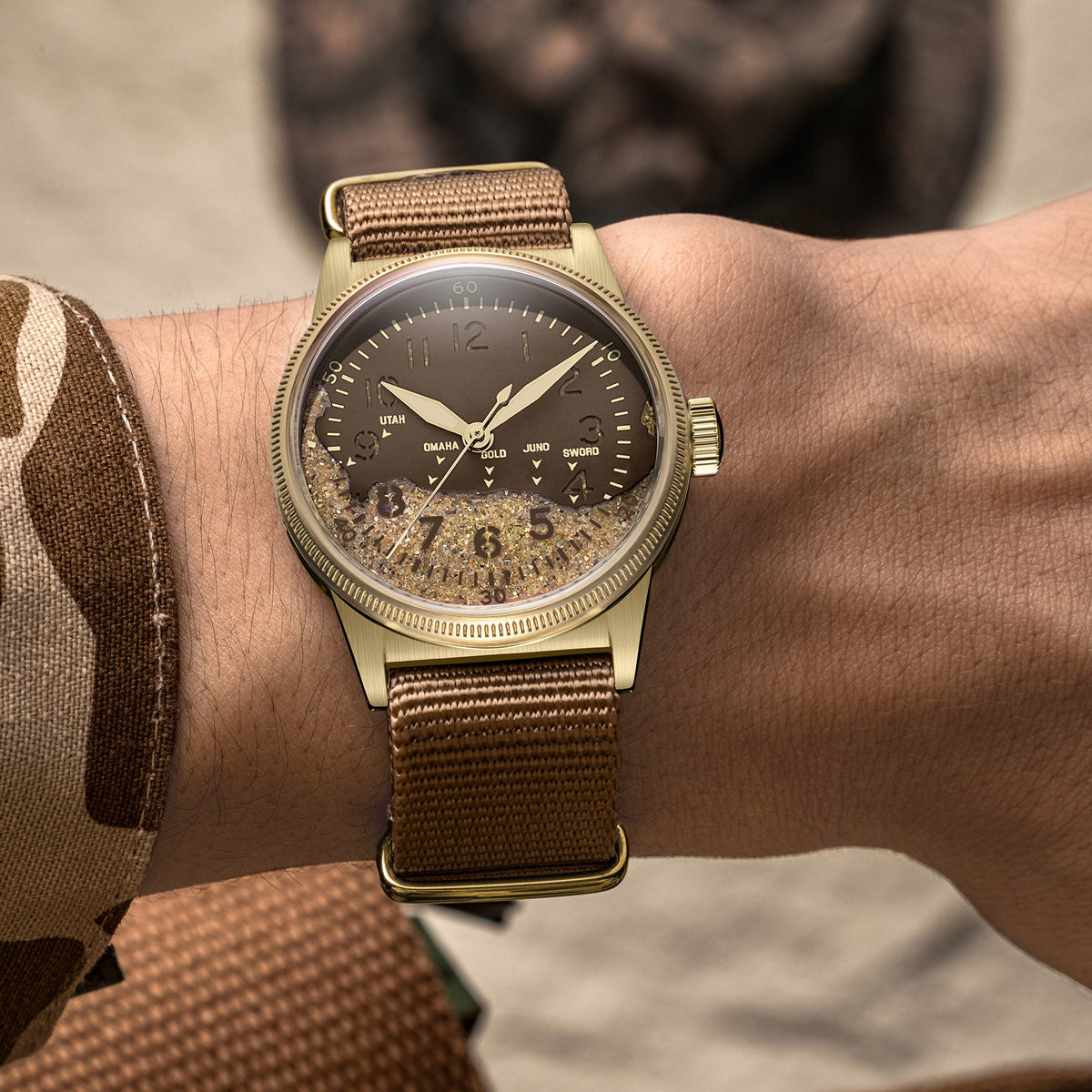
A bronze watch won't keep its showroom color forever. The bright, warm case you first put on your wrist gradually takes on darker tones as its surface reacts with the world around it. For someone who enjoys an object gaining visible age, that's a large part of the appeal. You get to wear the watch while its finish develops.
Our A-11 Utah Beach Sand MK2 Bronze brings that changing metal together with something already full of history: real sand from Utah Beach, set into the dial. Before we get to that watch, it helps to understand what bronze patina actually is, what affects it and how to look after a case without treating every change in color as a problem.
What happens when a bronze watch develops patina?
Bronze is a family of copper-based alloys, rather than one fixed recipe. Traditional bronze combines copper and tin. Other bronze alloys use different additions, including aluminum, which means two watches described as bronze needn't age in exactly the same way.
At the surface, the metal reacts with its environment. Air, moisture and other substances can produce compounds that change its color. This layer is what we call patina. Depending on the alloy and exposure, copper alloys can develop brown, darker or greenish surfaces. A bronze watch doesn't have to turn bright green to be aging normally.
Patina is part of a corrosion process, but corrosion doesn't always mean a case is falling apart. A stable surface layer and active, damaging corrosion are different conditions. The distinction is useful when you're caring for a watch: an evenly darkening finish isn't the same thing as loose powder repeatedly appearing in one spot.
The Canadian Conservation Institute's guidance on copper and copper alloys describes the range of surface changes these metals can develop. The practical lesson for a watch owner is to pay attention to the condition of the surface, rather than judging it by color alone.
Why does one bronze case look different from another?
The alloy is the starting point. How the watch is worn and stored matters too. Moisture, salts and handling affect the surface, so a photograph of someone else's bronze watch is an example, not a timetable for yours.
There isn't a useful universal answer to “How many weeks until it looks aged?” A case can start changing before its owner notices, and the result won't necessarily develop evenly. Areas that get touched or rubbed can look different from less exposed areas. That's one reason a naturally aged finish has more variation than a single factory-applied color.
If you're choosing bronze because you like this variation, let it happen through ordinary wear. You don't need a home chemistry experiment to make the watch interesting. Forced-patina methods can give a fast result, but they also mean putting substances on an assembled watch that its maker may never have approved for the case, seals, crystal or strap.
And if you want the case to stay the same color year after year, be honest about that before buying. Bronze is an appealing choice when the changing finish is something you want to live with, rather than something you'll constantly try to prevent.
Bronze on the A-11 Utah Beach Sand MK2
After the first Utah Beach A-11, we returned to the beach to collect sand for the next edition. The Utah Beach Sand MK2 Bronze followed in 2025, developed for the 81st anniversary of D-Day in partnership with the Utah Beach Landing Museum. It was our first watch made with a bronze case.
That case is solid CuAl8, an aluminum bronze. The alloy matters here: a photograph of a copper-and-tin bronze watch won't tell you exactly how this case will change.
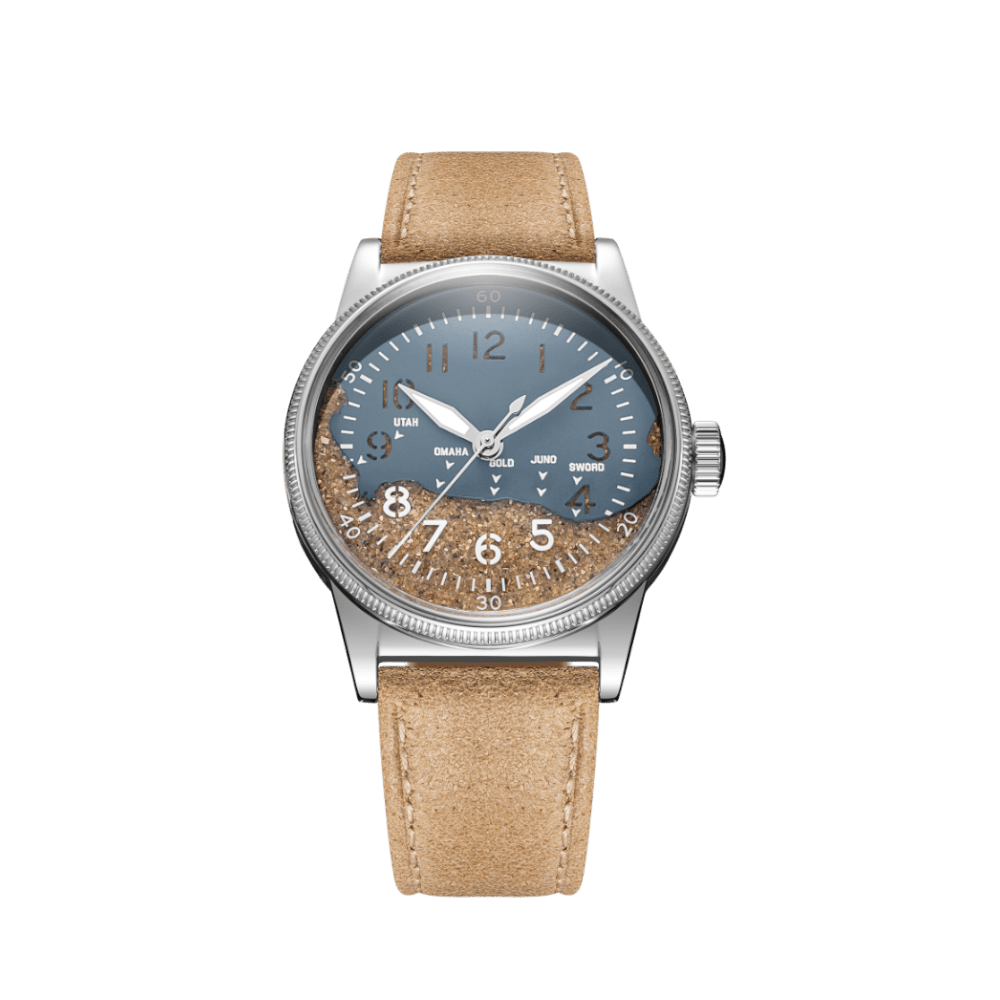
The reason to look closely at this watch starts with the dial. Sand collected from Utah Beach sits beneath a cutout shaped around Normandy's coastline. The design marks the five D-Day landing beaches: Utah, Omaha, Gold, Juno and Sword. On the upper half, openings in the dial let the sand show through as hour markers. The lower half uses printed indexes over the sand.

That gives the watch two quite different surfaces to notice. The dial carries the texture of the beach. The bronze surrounding it begins with a warm metallic finish and changes as you wear it. It's a modern commemorative design built around material from the place it remembers.
The 38 mm case keeps that detailed dial in a compact format, with a double-domed acrylic crystal above it. Inside is a Miyota 9039 automatic movement, which winds as the watch moves on your wrist. If you're deciding how 38 mm might fit your wrist, our watch size guide explains why the diameter is only part of the picture.
Current strap choices include Brown Leather, Sand Leather and Beige NATO. Leather suits the warmer colors of the bronze and sand; the fabric option changes the feel without changing the watch itself. Choose the combination you actually want to wear, then let the case develop at its own pace.

How to care for a bronze watch
Start gently. Our watch-care guidance recommends a microfiber cloth and a soft brush for cleaning. That is a sensible starting point for removing everyday surface dirt without trying to remove the finish beneath it.
A few habits make ownership easier:
- Wipe the watch after wear rather than leaving dirt and perspiration on the case.
- Keep a leather strap away from prolonged or frequent water exposure. The case's water-resistance rating doesn't make the leather waterproof.
- Keep the crown fully secured and follow the watch's water-use instructions. Don't operate it underwater.
- Avoid abrasive scrubbing and household chemical treatments. Ask us before using a product intended to strip or artificially accelerate patina.
- If you see recurring powdery deposits, flaking or pitting, have the watch assessed instead of assuming every surface change is harmless.
Cleaning and polishing aren't the same job. Cleaning removes dirt. Polishing can remove surface material and alter the finish you were trying to preserve. If your goal is to make an aged case bright again, contact our team for advice on the specific watch before reaching for a metal polish or an online recipe.
Is bronze the right watch material for you?
The best reason to choose bronze is that you like how it changes. A small difference in tone isn't necessarily something to fix. It can be the feature that makes you keep looking at a watch you've already owned for a while.
On the Utah Beach Sand MK2 Bronze, that changing case sits around a dial whose connection to Normandy is physical. If that combination appeals to you, explore the available straps and take a closer look at the sand and coastline detail. For more of the history behind the landing, our Higgins boat article follows the craft that carried men and equipment toward Utah Beach.
Frequently asked questions
What is bronze watch patina?
Patina is the surface layer that develops as a bronze case reacts with its environment. It can change the metal's color and appearance over time. Bronze alloys vary, so the result depends on the specific alloy as well as moisture, handling and other exposure. There is no single finish every bronze watch reaches.
Will a bronze watch turn green?
It can develop greenish surface compounds, but that isn't a guaranteed result or the only normal appearance. Copper alloys can also develop brown or darker patinas. Color alone doesn't tell you whether a surface is stable. Recurring loose powder, flaking or pitting should be assessed rather than dismissed as ordinary aging.
Can I remove patina from my bronze watch?
Patina can be altered or removed, but the method matters on an assembled watch. Household acids, abrasives and metal polishes may affect more than the bronze surface. If you want to restore a brighter finish, contact our team for model-specific guidance rather than assuming a recipe for a loose piece of metal is suitable.
What bronze does the Praesidus A-11 Bronze use?
The A-11 Utah Beach Sand MK2 Bronze has a solid CuAl8 bronze case. It was Praesidus's first bronze watch, developed for the 81st anniversary of D-Day in 2025. Its dial incorporates real sand collected from Utah Beach, with a coastline-shaped design marking Normandy's five D-Day landing beaches.

Leave a comment
This site is protected by hCaptcha and the hCaptcha Privacy Policy and Terms of Service apply.