

A watch you wear every day and a watch you pick up once a week ask different things of you. One can stay wound through regular wear. Another will keep running in the drawer. A third gives you a small job before you put it on: turn the crown and wind it. That difference matters more than deciding which movement sounds the most impressive.
Our Praesidus field watches include quartz, automatic and hand-wound options because there are good reasons to choose each. The first thing to clear up is the terminology: an automatic watch is a mechanical watch. When a listing compares “automatic” with “mechanical,” it usually means automatic versus manual winding. Quartz is the separate electronic approach.
The difference in one table
| What changes | Quartz | Automatic mechanical | Manual-wind mechanical |
|---|---|---|---|
| Energy source | Electrical energy, usually from a battery | A wound mainspring | A wound mainspring |
| How you keep it running | Replace or recharge its battery as designed | Wrist movement turns a rotor that winds the mainspring; many also allow crown winding | Turn the crown to wind the mainspring |
| When you leave it unworn | Keeps running while it has electrical power | Stops when the stored power runs out | Stops when the stored power runs out |
| Typical timekeeping | Generally more accurate than ordinary mechanical watches | Expect some daily variation | Expect some daily variation |
| Best reason to choose it | Convenience and accurate timekeeping | Mechanical operation with self-winding during wear | A hands-on winding routine and the appeal of the particular watch |
The movement is only part of the choice. Case size, water resistance, legibility and how the watch feels on your wrist still matter. An automatic isn’t automatically tougher, and a quartz movement doesn’t make the rest of a watch disposable.
Quartz: ready when you reach for it
In a quartz watch, an electronic circuit uses the regular vibration of a quartz crystal to keep time. In an analog watch, the circuit controls a motor that moves the hands. The battery supplies the energy; the crystal provides the timing reference.
That is useful if you rotate between watches. Leave a battery-powered quartz watch unworn for a week and it can carry on keeping time without you doing anything. You don’t need to keep its spring wound, because it doesn’t have one powering the watch.
Quartz also generally offers better timekeeping accuracy than an ordinary mechanical movement. The precise tolerance belongs to the individual caliber, though. “Quartz” isn’t one universal specification, just as “automatic” isn’t one accuracy grade.
The ownership trade-off is battery replacement on a conventional battery-powered model. Battery life varies with the movement and its functions. Solar quartz watches recharge from light instead, but they are still quartz watches, not automatic mechanical watches.
Does a ticking seconds hand mean quartz?
Often, but not always. Many analog quartz watches move their seconds hand once per second. Others move it in smaller steps, giving it a smoother-looking sweep. Our Jungle Field quartz uses that second approach. Watching the hand is a useful clue, not a reliable way to identify every movement.
Automatic: mechanical, with a rotor doing the winding
A mechanical watch stores energy in a mainspring. As the spring unwinds, it drives a gear train, while the escapement and balance regulate the release of that energy. The movement divides it into the small, controlled steps that keep the hands moving.
An automatic adds a weighted rotor. Your wrist movement moves that rotor, which winds the mainspring. It doesn’t charge a battery. Once you understand that, “automatic versus mechanical” becomes a much simpler question: do you want the watch to wind itself as you wear it, or do you want to wind it yourself?
For someone wearing the same watch regularly, automatic winding is convenient. But wearing it isn’t an unlimited power guarantee. How much you move and how long you wear it affect how much energy goes back into the spring.
If the watch stops after time off your wrist, that can simply mean its power reserve has run out. Power reserve is how long a fully wound movement can run without receiving more energy. A partly wound watch won’t necessarily deliver its advertised full reserve.
Many automatics, including the NH35 used in our Tom Rice A-11, can also be wound through the crown. Follow the instructions for the actual watch to start it, set it and put the crown back into its normal position. You don’t need to buy a watch winder just to own an automatic; resetting a watch after it stops is an ordinary part of wearing one.

Manual wind: the winding is part of wearing it
A manual-wind watch uses the same basic spring-powered approach without an automatic winding rotor. You supply the energy by turning the crown. That makes the routine more deliberate: you know when you last wound it, and you decide when to do it again.
Some people enjoy that contact with the mechanism. Others would rather not think about it before leaving the house. Neither preference needs defending. If winding would become an annoyance, choose the convenience you actually want rather than buying a manual watch because it sounds more traditional.
Follow the model’s winding instructions and don’t force the crown when you reach its normal stopping resistance. The right schedule depends on the watch’s power reserve and how consistently you wind it. There isn’t one winding count that works for every movement.
A manual movement isn’t inherently more accurate or better made than an automatic. The choice is about the particular watch and the way you want to use it. Removing the rotor can also help a design stay slim, but you still need to compare the finished case rather than assuming every manual watch is thinner.
What changes over a few years of ownership?
Quartz is usually the simpler option if your priority is keeping accurate time with little attention. Mechanical watches ask you to accept some variation and occasional adjustment. Paying more for a mechanical watch can buy you design, finishing, materials or a movement you find interesting; it doesn’t necessarily buy better accuracy than quartz.
Both types need care. A quartz watch may need a battery, seals or other work. A mechanical watch may need servicing to address lubrication, wear or performance. Battery replacement and a full movement service are different jobs, so don’t treat them as interchangeable maintenance costs.
Ask about the service recommendation for the watch you’re buying instead of applying a fixed interval to every movement. If it suddenly starts running very differently, gets wet inside or suffers an impact, have it checked rather than waiting for a calendar reminder. After opening a water-resistant watch, appropriate seal inspection and testing matter before relying on its water resistance again.
Keep the watch away from strong magnets, and check its stated water and shock resistance rather than assuming the movement type tells you how tough it is.
Three Praesidus watches, three different ways to wear one
Jungle Field quartz: compact and straightforward
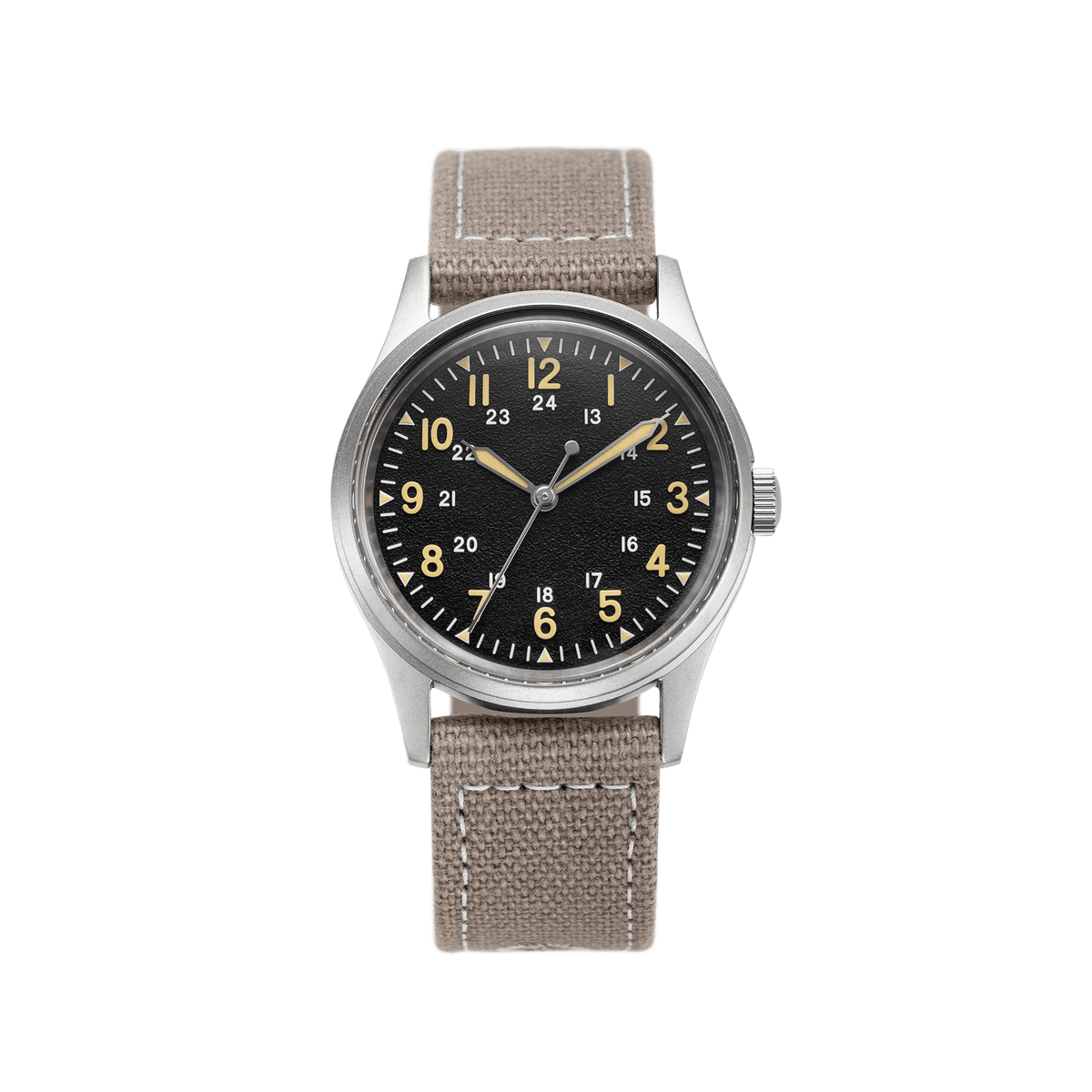
The Jungle Field Popcorn Patina takes its design cues from Vietnam-era field watches, with a compact 34mm case and a dial built around clear numerals. It’s a good place to start if you like those proportions but want a watch you can put down between wears without planning a winding routine.
Its TMI VH31 quartz movement gives the seconds hand a sweeping appearance while keeping battery-powered convenience. You get that movement across the dial without needing to keep a mainspring wound. If size is your next question, our watch size guide explains how diameter and lug-to-lug length work together on the wrist.
Tom Rice A-11: an automatic with a story behind it
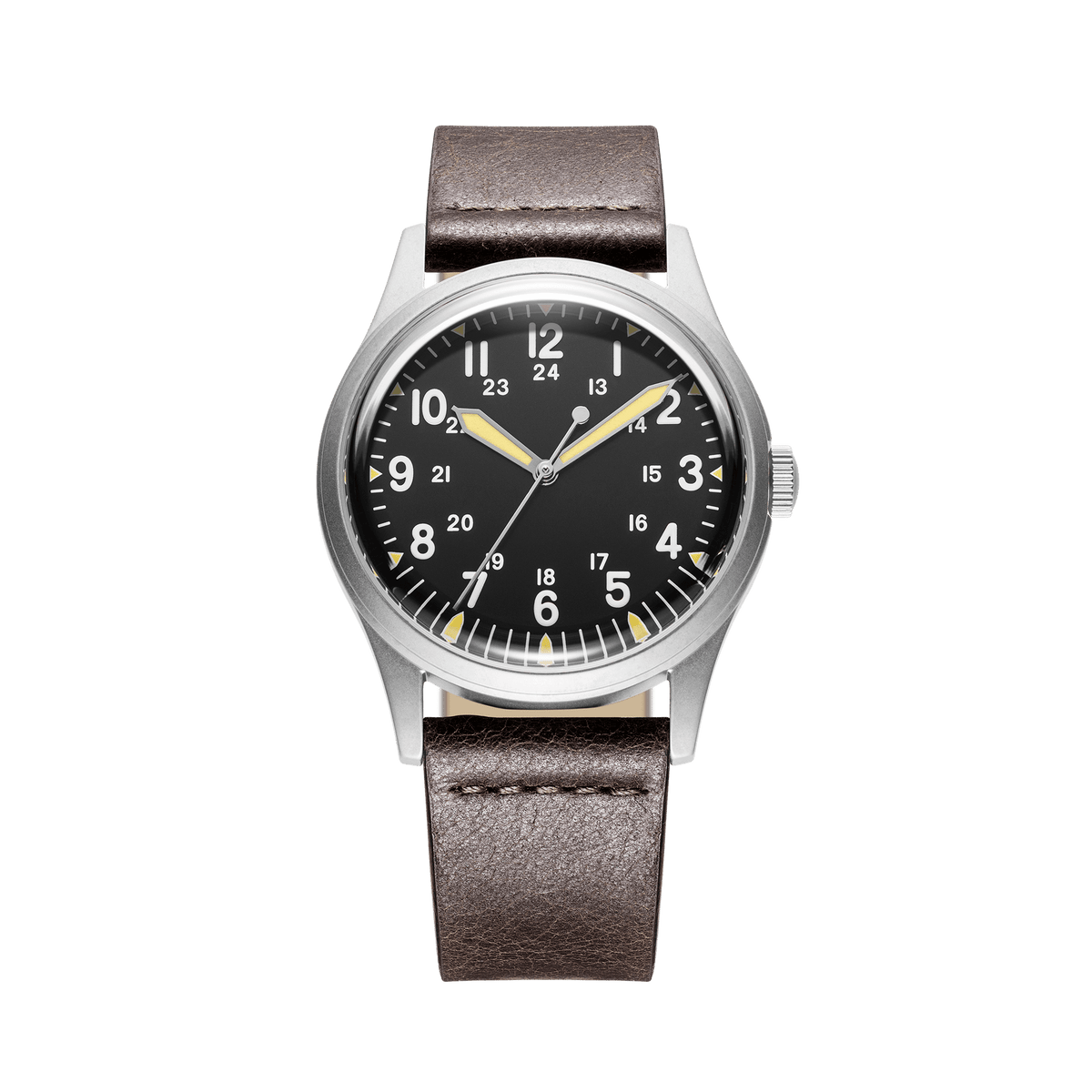
The Tom Rice A-11 on brown leather belongs to the collection that started Praesidus. Rice’s account of losing his A-11 during his D-Day jump helped set that project in motion. The watch gives that story a form you can wear regularly, with a choice of 38mm or 42mm proportions.
Its NH35 automatic movement suits someone who wants a mechanical watch for regular wear, with hand winding available when needed. The appeal is the combination of that A-11 identity and a practical everyday movement. Our automatic watches under $500 guide compares it with other automatic options.
Type 44: for someone who wants to wind their watch
The A-11 Type 44 grew from our effort to get closer to an original wartime A-11. Buying a 1944 Waltham helped us reconsider the proportions and develop a 32mm version alongside the 38mm design. Those original proportions remain central to the Type 44.
The current Type 44 uses a Swiss-made Landeron L21 manual-wind movement. You wind it through the crown, making that small, regular interaction part of owning the watch.

Choose the routine you want
If you want to pick up a watch after a week away and find it still running, quartz makes a strong case. If you want spring-powered mechanics in a watch you wear regularly, try an automatic. If you enjoy winding and the particular watch is one you want to spend time with, manual wind is a perfectly practical choice.
Then look at the complete watch. The right movement in a case you don’t enjoy wearing won’t get much wrist time.
Watch movement FAQs
Is an automatic watch a mechanical watch?
Yes. An automatic is a mechanical watch with a rotor that winds its mainspring as your wrist moves. A manual-wind mechanical watch relies on crown winding instead. Both store energy in a spring; quartz watches use an electronic timing system powered by a battery or another electrical source.
Which is more accurate, quartz or automatic?
Quartz watches are generally more accurate than ordinary automatic watches, but the exact tolerance depends on the movement and its conditions of use. Check the specification of the model you’re considering. A higher price or an automatic movement does not, by itself, promise more accurate timekeeping.
Will an automatic watch stop if I don’t wear it?
Yes, once its stored power runs out. The time depends on its power reserve and how fully wound it was when you took it off. That is normal operation, not necessarily a fault. Restart and set it according to the instructions for your particular watch before wearing it again.
Does a sweeping seconds hand mean a watch is mechanical?
No. Many mechanical watches have a smooth-looking seconds hand, but some quartz movements also move their hands in several steps per second. The VH31 in our Jungle Field quartz is one example. Check the movement specification rather than using the seconds hand alone to identify how a watch works.


Leave a comment
This site is protected by hCaptcha and the hCaptcha Privacy Policy and Terms of Service apply.