

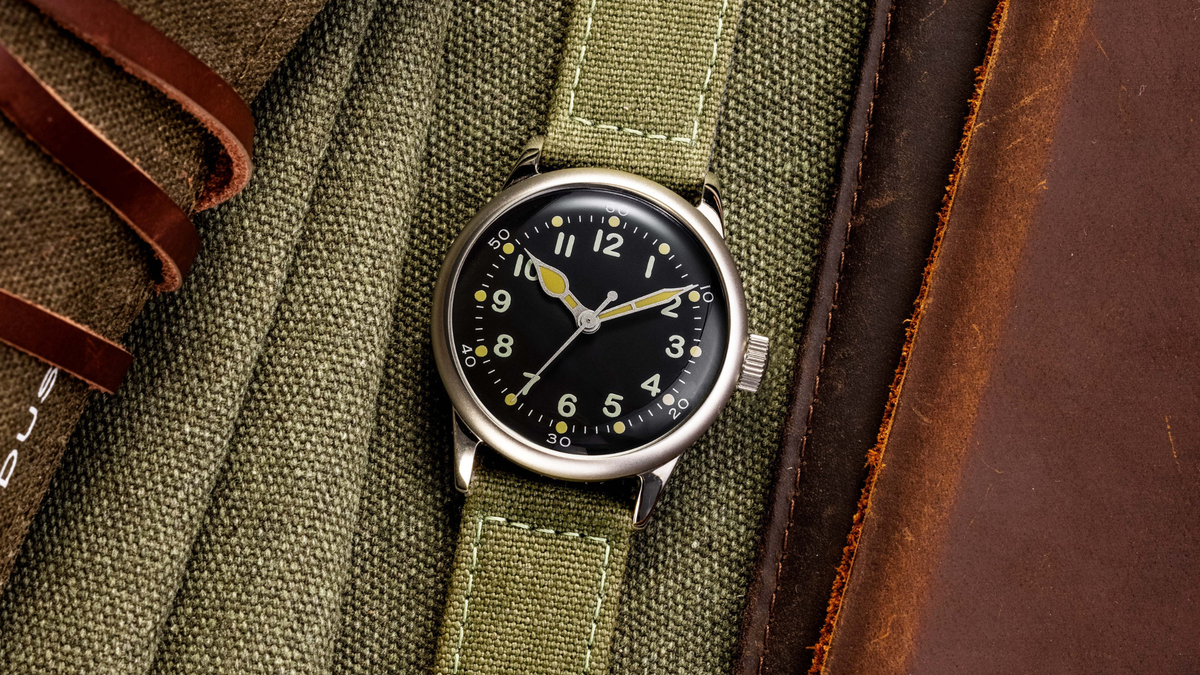
We hadn’t planned to make a 32mm Type 44. Our early design was 38mm. Then we bought an original 1944 Waltham A-11, and getting closer to that watch became a much more interesting project.
Its size mattered. So did the acrylic crystal and the way it was wound. Studying the original pushed us to reconsider choices we had already made, including finding a manual-wind movement that would fit the smaller case.
Collecting vintage military watches gives you that opportunity to examine the equipment itself. You can compare watches made by different manufacturers, follow the markings on a caseback and discover what has been replaced during decades of use. Sometimes there is paperwork connecting a watch to its original sale or an individual owner. Often, you have to work with the object in front of you.
For a first purchase, it helps to understand the watch’s background before judging its condition or price. The American A-11 and British W.W.W. watches are two places to start.
The A-11: a WWII navigation watch
Elgin, Waltham and Bulova produced watches to the American A-11 specification during World War II. A central seconds hand and a hacking mechanism allowed the wearer to stop the seconds while setting the time, then restart against a shared reference. That ability was useful in navigation, where accurate timing formed part of the job.
The designation describes a specification. An Elgin A-11 and a Waltham A-11 can therefore belong to the same family while differing in their construction. When examining an original, the maker and production details help establish which movement, case and dial configuration you should expect.
The National WWII Museum’s account of American wartime watches explains the A-11’s navigation role. Our A-11 history follows the design in more detail.
British W.W.W. watches and the Dirty Dozen
The British W.W.W. watches date to the closing period of World War II. W.W.W. refers to their equipment designation: Watch, Wrist, Waterproof. Collectors now know the twelve manufacturers that supplied them as the Dirty Dozen.
The group includes Buren, Cyma, Eterna, Grana, Jaeger-LeCoultre, Lemania, Longines, IWC, Omega, Record, Timor and Vertex.
Put several examples beside one another and the shared requirements become visible. Black dials, Arabic numerals and small seconds displays near six o’clock give them a family resemblance. Then the differences emerge in the case shapes, lettering and movements.
You can concentrate on a single manufacturer or work toward collecting the twelve. Either approach rewards learning the details of individual examples. Our Dirty Dozen article introduces the manufacturers and their watches.
“Waterproof” is part of the historical designation. A surviving watch’s present-day resistance to water depends on its condition.
How to identify a vintage military watch
Start by asking the seller for clear photographs of the dial, caseback and movement. Movement photographs should come from someone qualified to open the watch. You need enough detail to read the markings and compare them with records for that particular maker and reference.
An IWC W.W.W. cataloged by Christie’s gives us a useful example. The listing records case number 1,136,397 and military number M17417, along with an IWC archive extract confirming the watch’s sale on February 21, 1945.
Those numbers identify the particular watch being described. As a buyer, you can compare them with the photographs and accompanying paperwork, rather than relying on a general description such as “British Army watch, circa 1945.”
The archive extract supports the recorded sale date. It does not establish that every component remains original or identify the soldier who wore it. A connection to a named owner or battle needs its own supporting records.
Original parts, servicing and replacement components
A vintage watch may have been maintained by several watchmakers over its life. Ask what work is documented and which parts were changed.
Cleaning, lubrication and adjustment can be carried out while retaining existing components. A replacement crown changes a component. Repainting the dial changes its finish and markings. Those interventions have different consequences for someone collecting original examples.
A correct service replacement can make a watch usable again, but it should be described as a replacement. Equally, a watch advertised as “serviced” needs more explanation: when was the work done, by whom, and what did it involve?
Have a watchmaker familiar with the reference assess anything you cannot resolve from the photographs and records. An attractive dial and a running movement leave plenty of questions unanswered.
What affects a vintage military watch’s value?
Two watches from the same maker can have very different asking prices. Before paying more for one, work out what accounts for the difference.
An original dial with legible printing may appeal more to a collector than a freshly refinished one. Case condition matters too. Heavy polishing can soften edges and reduce the clarity of markings. A brighter-looking watch is not necessarily the better-preserved example. Sotheby’s guide to watch condition explains why originality and retained case proportions receive so much attention.
Mechanical condition affects the cost of ownership. A cheaper watch needing substantial work may leave you spending more than an example with a documented recent service. Ask a specialist about likely work and parts availability before treating the asking price as your total budget.
Rarity and demand also influence price. A hard-to-find example may attract collectors trying to complete a group, while another buyer may prefer a more common watch in better condition. Scarcity alone does not tell you which purchase will suit you.
Documentation can explain a premium when it establishes something specific about the watch. A manufacturer’s record may support its date; family records may connect it to an owner. A seller’s unsupported account of wartime service gives you much less to assess.
Compare completed sales of closely comparable examples where possible, and read the condition descriptions. At auction, check whether the reported price includes the buyer’s premium. Differences in fees, servicing and restoration can make apparently similar prices difficult to compare.
Caring for a vintage military watch
Before wearing a newly acquired watch regularly, have its condition assessed. Running when wound does not tell you how well the movement is lubricated or whether the case seals still protect it.
Discuss the work before authorizing it. If you want to preserve the dial finish, case markings and existing components, tell the watchmaker. Keep photographs and service records with the watch so you and any later owner can follow what changed.
Old luminous paint may need specialist handling. Do not scrape, sand or disturb it yourself. Choose someone familiar with vintage luminous materials to assess it.
Why we made the A-11 Type 44
Working from the Waltham gave us a clear reason to pursue the smaller Type 44. We wanted to preserve the compact feel of the original, which meant making room for a suitable movement inside a 32mm case.
As we explain in the Type 44 origin story, we worked with Soprod to adapt its P024 movement for manual winding. The acrylic crystal stayed, too.
The A-11 Type 44 collection offers both 32mm and 38mm versions, now with Swiss-made Landeron L21 manual-wind movements. Choose 32mm if the compact proportions are what draw you to watches of the period. The 38mm version gives the dial more room on the wrist. Leather, canvas and Bonklip bracelet options let you choose how you want to wear it.


Leave a comment
This site is protected by hCaptcha and the hCaptcha Privacy Policy and Terms of Service apply.