



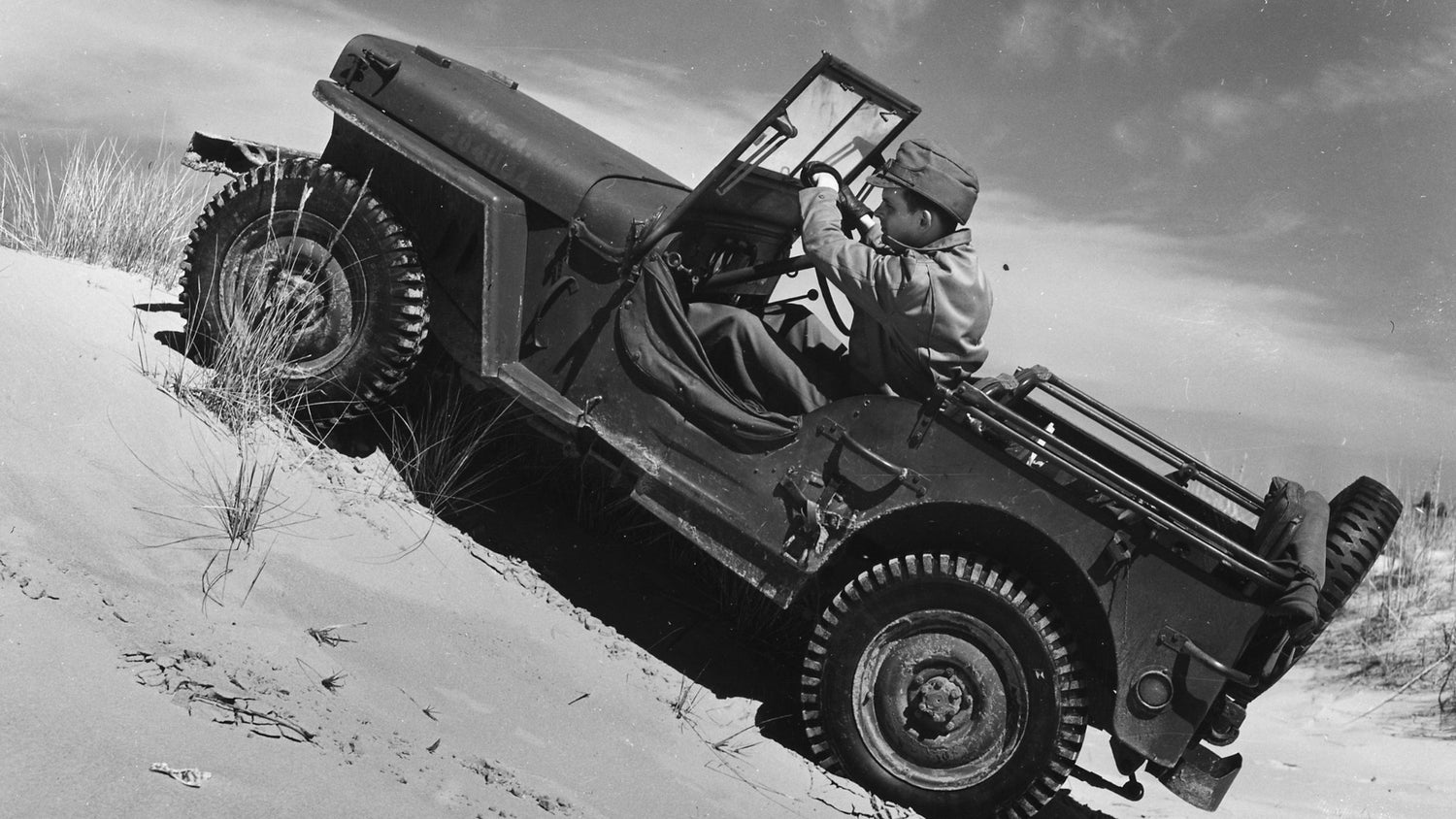
How a desperate Army competition, a freelance designer working for free, and a stubborn flathead engine produced the most important military vehicle in history.
The Willys MB was not a complicated machine. No doors. No roof. Barely enough instrumentation to call it a dashboard. But between 1941 and 1945, over 640,000 of them were built, and they went everywhere the war did - North Africa, the Pacific, Western Europe, the beaches of Normandy. Dwight D. Eisenhower called it "America's greatest contribution to modern warfare." War correspondent Ernie Pyle put it differently: "It did everything. It went everywhere. Was as faithful as a dog, as strong as a mule, and as agile as a goat."
A War Department in Need
By the late 1930s, American military planners had been watching the German Blitzkrieg move through Europe and taken notes. The Wehrmacht's speed depended on mechanized mobility - something the U.S. Army could not match. Its light vehicles were aging and poorly suited for cross-country work. Reconnaissance and liaison missions required something faster, more capable, and more reliable than anything currently in service.
On May 27, 1940, the Technical Armament Committee signed off on formal specifications for a new vehicle: a quarter-ton, four-wheel-drive light reconnaissance car. The requirements were specific. All-wheel drive. Open body, roughly rectangular. 80-inch wheelbase. Three seats. Maximum weight of 1,300 pounds - a figure that would prove nearly impossible to hit. Minimum 40 horsepower. Low enough to pass beneath a three-foot obstacle.
In July 1940, the War Department sent invitations to 135 American automobile manufacturers. The deadline: 49 days to deliver a working prototype, 75 days to produce a pilot run of 70 vehicles.
Two companies responded. American Bantam Car Company of Butler, Pennsylvania, and Willys-Overland Motors of Toledo, Ohio. Ford joined the competition shortly after. It was Bantam - a company that had been near bankruptcy for years - that moved first.
Bantam Fires the Opening Shot
By any reasonable measure, Bantam should not have been in this race. The company ran on a skeleton workforce and a shrinking product line. But its chief engineer, Harold Crist - who had worked on the first Duesenberg and spent 18 years at Stutz before landing in Butler - knew how to move fast. He brought in Karl Probst, a freelance automotive designer from Detroit. Probst had initially said no to the project. He changed his mind after a direct request from the Army, and agreed to work without pay.

Probst drew up complete design schematics for the Bantam Reconnaissance Car prototype in two days. Cost estimate the next day. Bantam submitted its bid on the July 22 deadline. The finished prototype was delivered to Camp Holabird, Maryland, on September 23, 1940 - inside the 49-day window with almost nothing to spare.
At Fort Holabird and Fort Knox, the BRC climbed 60-degree grades and survived a 40 mph collision with a truck on the drive back from Kentucky. The Army was satisfied.

The problem was production capacity. The military needed potentially hundreds of thousands of these vehicles. A company with fewer than 500 employees couldn't build them. In a move that remains controversial, Army officials passed Bantam's blueprints to both Willys-Overland and Ford and asked them to develop competing prototypes from the same foundation.
The Three-Way Competition
The Army ordered 1,500 units from each manufacturer for comparative testing.
Bantam produced the BRC-40 - recessed headlights, a ten-bar grille, and the solid chassis that had performed well in the first round.
Willys-Overland fielded the Willys MA, evolved from its earlier "Quad" prototype. The Quad had come in overweight, but it had something the others didn't under the hood.
Ford entered the GP, running a modified N-series tractor engine with a Model A three-speed transmission. It was the weakest drivetrain in the field.
Willys won on power. In cross-country testing, hill climbing, and sustained work under load, the MA outperformed both competitors. The margin came down to one thing: the Go-Devil engine.
The Go-Devil Engine
The Willys L134 was a straight-four flathead displacing 134.2 cubic inches (2.2 liters). It was not a new design - it traced back to the four-cylinder first used in the 1926 Willys Whippet, which produced 30 to 48 horsepower and gave out after roughly 22 hours at sustained RPM.
What turned it into something useful was Delmar "Barney" Roos, Willys-Overland's chief engineer. Roos had come from Pierce-Arrow, Studebaker, and the Rootes Group before joining Willys in 1938. He went through the engine systematically: new aluminum pistons, reworked cam lobes, improved valvetrain, new crankshaft, full-pressure lubrication with insert bearings.
The result: 60 horsepower at 4,000 RPM and 105 lb-ft of torque at 2,000 RPM. Ford was pulling the same 60 horsepower from a much larger L-head V8 in the 1940 Ford Deluxe. Roos got there with an inline-four weighing 365 pounds.

The bore-stroke dimensions - 3.125-inch bore, 4.375-inch stroke - gave the engine torque-rich delivery well suited to low-speed off-road work. The L-head layout kept overall height down, which mattered for the Army's three-foot clearance requirement. The Army spec had asked for 85 lb-ft of torque at the rear axle. The Go-Devil cleared that by a wide margin.
From Contract to Production: The MB is Born
In July 1941, Willys-Overland received the initial contract for 16,000 vehicles. The production model was designated the Willys MB - "M" for military, "B" for the second design iteration after the MA. The MB incorporated refinements from all three competing prototypes: Bantam's Spicer-sourced four-wheel-drive transfer case, the Willys Go-Devil engine, and the body configuration Ford had developed for the GP - including its stamped vertical-slot steel grille, which was cheaper and lighter to produce than the alternatives. By April 1942, that grille was standard across all production vehicles.

Willys couldn't meet demand alone. By October 1941, Ford was brought in as a licensed second manufacturer. Ford's version was designated the GPW, with "W" indicating the Willys-licensed design. Both versions were built to identical specifications: 6.00×16 tires, sealed spring shackles, blackout lighting, spark suppression, trailer connections.
First unit cost: $738.74 (roughly $15,500 today).
Production at Scale
Between 1941 and 1945, Willys built approximately 363,000 MBs. Ford produced around 280,000 GPWs. Add Bantam's 2,675 BRC-40s and total production exceeded 640,000. This was the first mass-produced four-wheel-drive vehicle built in six-figure numbers in history.

That was roughly one quarter of all military support vehicles the United States manufactured during the war. An average of 145 went to each Army infantry regiment. Beyond U.S. forces, thousands were sent to Allied nations under Lend-Lease (the Soviet Union, the United Kingdom, Free French forces).

Everywhere, in Every Role
The MB was designed for reconnaissance and liaison. Within months it was doing everything else.
At 2,450 pounds, roughly 132 inches long and 62 inches wide, with genuine four-wheel drive and a top speed near 65 mph, it fit where larger vehicles couldn't and went where they wouldn't. Field mechanics pushed it further than its designers planned.
Reconnaissance and liaison. Low profile, tight turning radius, able to navigate terrain that stopped heavier vehicles. Fitted with radios, it became a mobile command post.
Weapons platform. Browning M1919 machine guns, .50-caliber M2HB mounts. In North Africa, the British Long Range Desert Group and the SAS ran MBs deep behind enemy lines with multiple guns, extra fuel, and additional water storage.

Casualty evacuation. Litters across the rear. It reached frontline positions that ambulances couldn't.

Artillery tractor. Anti-tank guns, ammunition trailers, communications equipment. The ability to reposition light guns quickly changed how commanders used them.
Field engineering. Modified with railway wheels, MBs ran on tracks. Engineers used them to power sawmills, drive water pumps, and lay cable across rough terrain.

Airborne delivery. Light enough to load into Waco CG-4A Hadrian and Airspeed Horsa gliders, MBs could be delivered directly into combat zones. The British Airborne Forces Experimental Establishment even tested the Hafner Rotabuggy - a passive rotor attached above the cabin to allow towed rotary-wing flight. It flew in late 1943. Glider delivery made it redundant before it saw service.

On D-Day, June 6th, 1944 MBs were among the first vehicles ashore at Normandy, moving officers, towing anti-tank guns, and running communications in the first hours after the landings. In the Pacific, the vehicle's compact footprint proved essential in jungle terrain where an M4 Sherman couldn't maneuver.
What the Troops Made of It
The MB was spartan by design. No doors, no roof, minimal instruments and basic seats. On the field, fewer components meant fewer failures. When something broke, a field mechanic with standard tools could usually fix it. Willys and Ford parts were interchangeable, which further simplified supply lines across every theater.
Soldiers wrote about the MB in letters home, in memoirs, in field dispatches. One was awarded a Purple Heart after sustaining battle damage and shipped back to the States - unofficial, but it said something about how troops felt toward a machine they'd depended on.

Ernie Pyle filed more dispatches mentioning the MB than almost any other piece of equipment. His picture of it was consistent: everywhere, always running, indispensable, and built with just enough to get the job done.
After the War
In 1945, Willys-Overland converted the MB into a civilian product - the CJ-2A, with the blackout lighting removed and a tailgate added. It was one of the first factory four-wheel-drive vehicles sold to the public, and farmers, ranchers, and rural workers bought it for the same reasons the Army had.

The military MB continued in service through Korea, updated as the M38 Willys MC (1949) and M38A1 Willys MD (1952), before Ford redesigned the platform as the M151 in 1960.
The design spread internationally. The Soviet Union produced the GAZ-67 from Lend-Lease BRC-40s. France's Hotchkiss built the M201 under license. Variants and derivatives appeared on every continent.
In 1991, the American Society of Mechanical Engineers recognized the Willys MB as an International Historic Mechanical Engineering Landmark. In 2010, the American Enterprise Institute called it one of the most influential designs in automotive history.
What the Willys MB Means to Praesidus
At Praesidus, the watches we build are tied to documented military history and its equipment. The Willys MB and the A-11 field watch share the same design logic: built to a government specification, produced at scale, with no features that weren't necessary and no tolerance for failure.
Over 640,000 were built. Millions of soldiers depended on them. The vehicle earned its reputation by working, under conditions that broke everything else and now we honor it in our 82nd Anniversary of D-Day Commemoration Piece: the A-11 LMUV.

On June 6, 2026 — the 82nd anniversary of D-Day — Praesidus releases the A-11 LMUV: a watch whose dial is cut directly from the recovered hood of a WWII Willys MB

Leave a comment
This site is protected by hCaptcha and the hCaptcha Privacy Policy and Terms of Service apply.